What Size Chicken Coop for 15 Chickens?
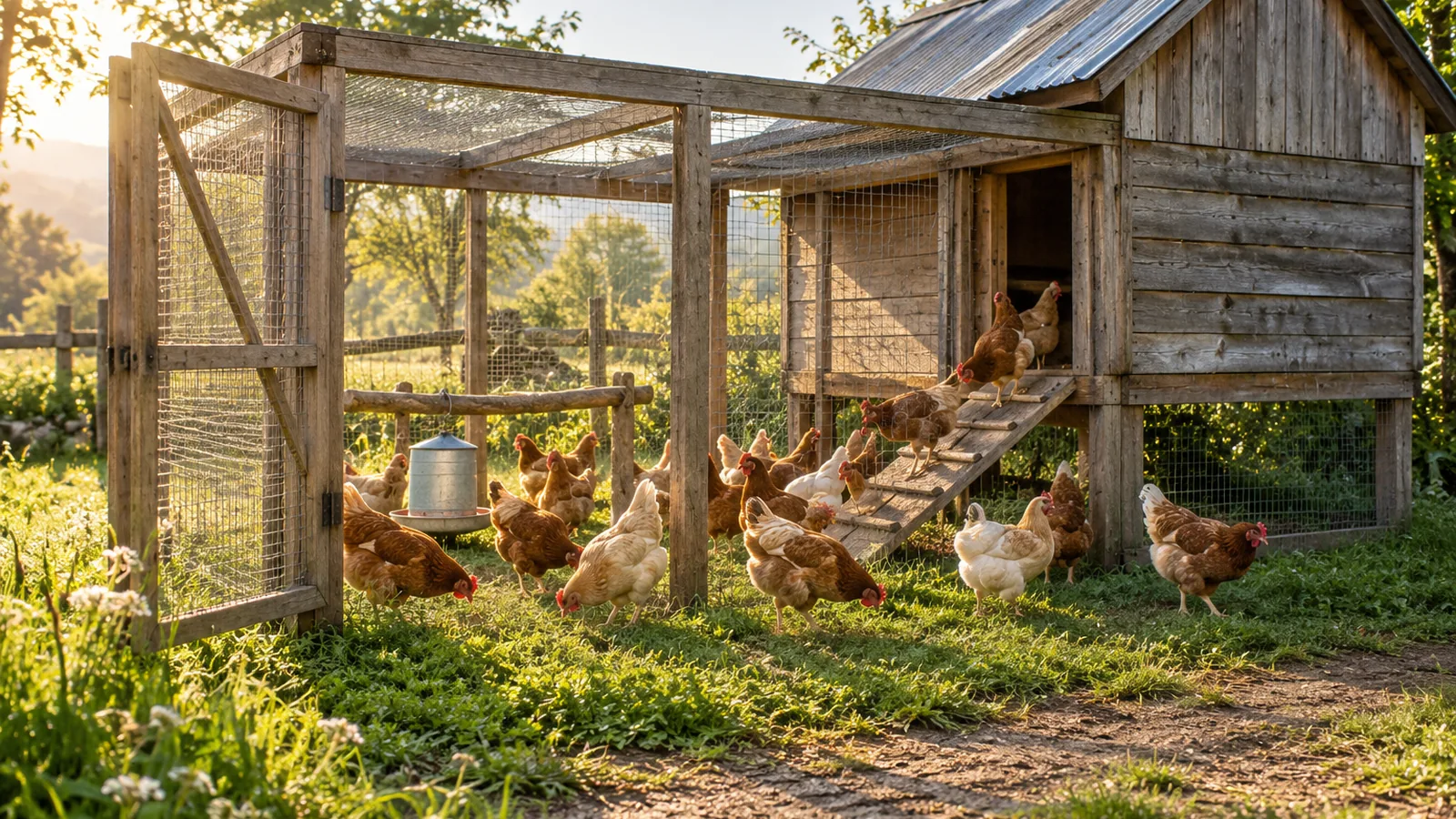
For 15 standard chickens with outdoor access, plan on about 37.5–52.5 sq ft of enclosed coop floor. Don’t count the outdoor run toward the coop total, and plan 60–75 sq ft of run on its own for the 15 birds.
Quick answer
what size chicken coop for 15 chickens?
For 15 standard chickens with outdoor access, plan on 37.5–52.5 sq ft of enclosed coop floor. A 6 × 10 ft coop gives exactly 60 sq ft and suits hens that spend stretches of winter indoors. Keep the run out of that total, because outdoor space doesn’t count toward indoor floor.
- Multiply the flock: 15 × 2.5 = 37.5 sq ft and 15 × 3.5 = 52.5 sq ft of indoor floor.
- Test a 6 × 8 ft coop: 48 sq ft, or 3.2 sq ft per bird, falls inside that range.
- Pick a 6 × 10 ft coop: at 4 sq ft per hen, the target is 60 sq ft, which it matches.
- Size the run at 10 sq ft per bird: 15 hens need 150 sq ft, such as a 10 × 15 ft run, if the birds rely on it.
Quick size chart for 15 chickens
For 15 chickens with outdoor access, plan on 37.5–52.5 sq ft of enclosed coop floor and a separate run of 60–75 sq ft.
| Area | Per bird | Total for 15 birds | Range in sources |
|---|---|---|---|
| Enclosed coop floor | 4 sq ft | 60 sq ft | 2.5–4 sq ft per bird (37.5–60 sq ft) |
| Outdoor run | 5 sq ft | 75 sq ft | 4–10 sq ft per bird (60–150 sq ft) |
At 4 sq ft per bird, 15 hens get 60 sq ft, which is the figure Poultry eXtension uses for a 6 × 10 ft coop. The 2.5 sq ft low end leaves less room for birds that spend long stretches inside. For the run, 5 sq ft per bird is Cornell’s upper value and gives the flock more room to move around.
How do you calculate coop and run space?
Multiply your chicken count by the space each bird needs, once for the coop and once for the run, and keep the two results separate. The coop formula is number of chickens × indoor square feet per chicken, which gives total indoor floor area in square feet. Square feet are length in feet × width in feet, so a 6 ft × 8 ft coop has 48 sq ft. For 15 birds at 3 sq ft each, the minimum Oregon State Extension gives for birds with outdoor access, you’d need 15 × 3 = 45 sq ft of floor.
The run formula works the same way: number of chickens × outdoor square feet per chicken = total run area. Extension guidance sets the outdoor figure at 4–5 sq ft per bird, so multiply 15 by that number to get your run target in square feet. Measure the run’s length and width in feet and multiply, just as you did for the coop.
Don’t add the run to the coop. Run area doesn’t count toward required indoor space, because chickens need enclosed shelter at night and during bad weather. A large run can’t make up for a small coop, so your coop total has to meet the indoor formula on its own.
Worked examples for 15 chickens
A 6 × 8 ft coop gives 48 sq ft, which fits 15 chickens, and a 6 × 10 ft coop gives 60 sq ft, which meets the higher target. Work through both sizes with the same steps.
Multiply the flock by the indoor allowance. Cornell Cooperative Extension advises 2.5 to 3.5 sq ft of indoor floor per bird. Multiply 15 by 2.5 to get 37.5 sq ft, and by 3.5 to get 52.5 sq ft.
Test the 6 × 8 ft coop against that range. Multiply 6 by 8 to get 48 sq ft. That works out to 3.2 sq ft per bird and falls inside the 37.5 to 52.5 sq ft range.
Test a 6 × 10 ft coop at 4 sq ft per hen. For 15 laying hens with outdoor access, 4 sq ft each sets the target at 60 sq ft, which a 6 × 10 ft coop matches exactly. Pick this size if your hens will spend stretches of winter indoors, because indoor space needs rise when weather keeps them out of the run.
Size the run separately at 10 sq ft per bird. Fifteen hens need 150 sq ft of outdoor run, so a 10 × 15 ft run supplies exactly that. Keep the run out of the coop total, because outdoor space does not count toward required indoor floor.
What changes the space you need?
Indoor floor needs drop when chickens get daily outdoor time and climb when they’re confined. For 15 birds, the three setups compare like this:
- Outdoor access, minimum: 3 sq ft per bird, or 45 sq ft for 15
- Outdoor access, range: 3–4 sq ft per bird, or 45–60 sq ft for 15
- No outdoor access: 8–10 sq ft per bird, or 120–150 sq ft for 15 birds
Bad weather is the main reason to plan above the minimum. Poultry eXtension notes that indoor needs increase when weather keeps birds from using the outdoors. If your area has long wet or snowy stretches, aim for the top of the range so birds have room to move when they can’t go out.
Bird size, breed, and how long they stay confined all shift these figures. Most extension numbers generally assume adult laying hens or standard backyard breeds, so check your breed’s size before you pick a number.
Capacity claims on prefab coops don’t follow a standard, so treat them as a starting point. Measure the usable enclosed floor area, then check whether the listed dimensions include a run. A coop with a large footprint that includes its run may leave less indoor room than the label suggests.
Space-saving essentials inside a 15-chicken coop
Plan on 75–150 inches of roost bar and about 4 nest boxes for 15 birds. Oregon State Extension recommends 5–10 inches of roost per bird, which works out to 75–150 inches for 15 birds. Penn State Extension‘s 6 inches per standard-size chicken comes to 90 inches. Oregon State also suggests about one nest box per four birds, or roughly 4 boxes.
Build the coop so you can reach every corner and the droppings area without crawling. A walk-in door on the side you use most makes daily chores faster and keeps you from stooping through the whole routine.
Check a prefab’s measured floor area before you buy, because capacity claims don’t always match the space inside. Listings can also include an overall footprint that is much larger than the coop box.
Prefab listings compared with their enclosed floor area:
| Model | Listed size | Enclosed floor area | Rated for |
|---|---|---|---|
| OverEZ Large | 74 × 60 in | About 30.8 sq ft | Up to 15 chickens |
| Triano Farms Estate | 8 × 24 ft overall, 4 × 8 ft coop box | 32 sq ft (coop box) | 15–16 hens |
Splitting 15 birds into two coops of 8 and 7 needs 20–28 sq ft and 17.5–24.5 sq ft of floor, which adds up to the same 37.5–52.5 sq ft total. Two smaller coops let you separate a sick or bullying hen and give you more room to move birds without rebuilding the whole setup. One large coop is simpler to maintain with a single set of nest boxes and roosts.
Frequently Asked Questions
Can a prefab coop advertised for 15 chickens really hold them?
Not always, so check the floor area before you trust the label. A Snap Lock Large coop, for example, lists 12–15 birds in about 17.3 sq ft of floor, well under the 37.5 sq ft minimum for 15 hens.
Is one large coop better than two smaller coops?
Usually no, because both layouts can meet the same indoor target. Your total floor still needs to fall in the 37.5–52.5 sq ft range for 15 birds. Choose one large coop if you want one set of roosts and nest boxes to clean, and choose two if you need to isolate a bird.
How much extra coop space do larger chicken breeds need?
Plan on about 0.5 sq ft more indoor floor per bird than you would for standard breeds. Penn State Extension lists 2 sq ft indoors per large chicken, compared with 1.5 sq ft for standard-size birds. The run allowance also rises from 8 to 10 sq ft per bird.
Should I plan extra coop space for future flock growth?
Yes, build for the flock size you expect to reach, because indoor space scales with bird count. At 2.5–3.5 sq ft per bird, 20 birds need 50–70 sq ft of floor.
Do local rules limit how many chickens I can keep?
Possibly, because flock limits are set by your city or county, not by coop size. Check local code before you buy birds. Once you know your cap, plan 2.5–3.5 sq ft of indoor floor per bird to fit it.
Conclusion
Note: No RESEARCH block was included with this request, so I could not check the [S#] markers against a source list. I kept the markers and figures from your draft and resolved its conflicting numbers (the run range and the indoor range). The Sources section is omitted because the draft gave no source titles or URLs.
Quick answer – Coop floor: 45–60 sq ft indoors for 15 hens with outdoor access, or 3–4 sq ft per bird. – Run: 60–150 sq ft outside, or 4–10 sq ft per bird.
Quick size chart for 15 chickens For 15 chickens with outdoor access, plan on 37.5–52.5 sq ft of enclosed floor at the lowest and higher allowances. Give the run its own space of 60–75 sq ft as a baseline.
Sources
- Backyard Chickens (warren.cce.cornell.edu)
- extension.psu.edu (extension.psu.edu)
- extension.psu.edu (extension.psu.edu)
- poultry.extension.org (poultry.extension.org)
- extension.oregonstate.edu (extension.oregonstate.edu)
- ask.extension.org (ask.extension.org)
- Raising chickens for eggs (extension.umn.edu, Wed, 21 Oct 2026 18:23:13)
- overezchickencoop.com (overezchickencoop.com)
- tractorsupply.com (tractorsupply.com)
- trianofarms.com (trianofarms.com)
- lancasterbarns.com (lancasterbarns.com)
- deercreekstables.com (deercreekstables.com)
- fourleafcoop.com (fourleafcoop.com)