How Much to Build a Chicken Coop for Your Flock
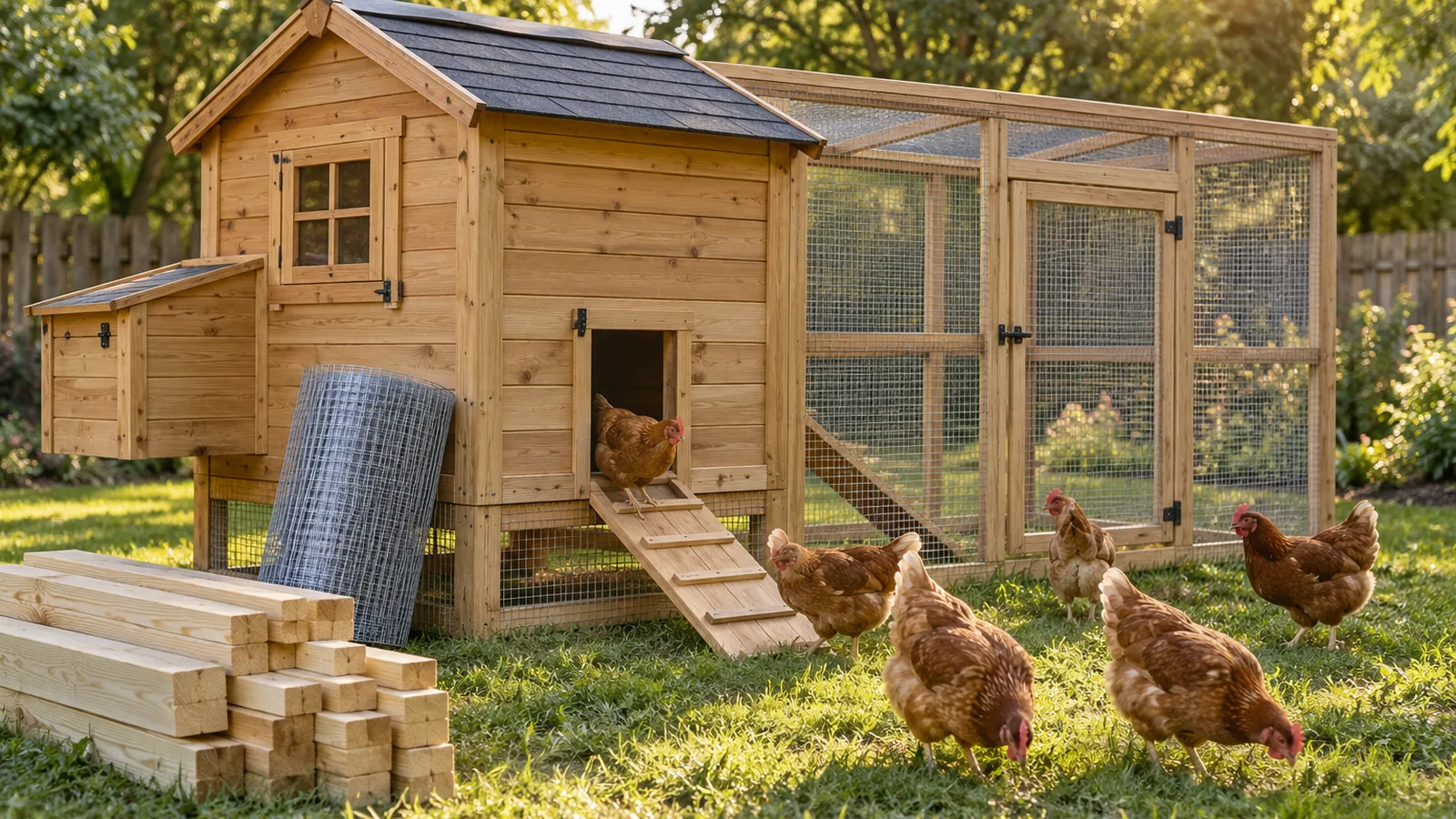
A DIY coop for six hens typically costs $150–$400 in materials for a 4 × 6 ft build. A setup for six birds that includes a 90-foot run comes to roughly $600. Plan for the run as well as the coop when you set your budget.
Quick answer
How much does it cost to build a chicken coop?
Expect about $150–$400 in materials for a DIY coop for six hens in a 4 × 6 ft size, $300–$800 for prefab, and $800–$2,000+ for custom construction. The total depends mostly on whether a run is included, since Fixr’s six-chicken example of about $600 covers an 18-square-foot coop plus a 90-foot run. Treat these as planning estimates rather than verified quotes, and compare only quotes with the same scope.
- Indoor space: give six hens 18–24 square feet inside, at 3–4 square feet per bird.
- Run space: allow 10 square feet per bird outside, or 60 square feet for six hens.
- Predator mesh: a 4 × 50-foot roll of ½-inch, 19-gauge galvanized hardware cloth lists at $99.98, and extension guidance says to bury it at least 12 inches deep.
- Plywood: a 19/32-inch, 4 × 8-foot sheet lists at $33.28, or $29.95 each at 58 or more sheets.
- Labor: add about $70 per hour only if you hire a custom carpenter.
Chicken Coop Costs at a Glance
Style changes the price a lot: a chicken tractor runs $300–$500, and an all-in-one coop with an attached run costs $1,000–$3,000.
| Type / tier | Typical range (USD) | What you get |
|---|---|---|
| DIY coop, six hens | $150–$400 | Materials for a 4 × 6 ft coop |
| Prefab coop, six hens | $300–$800 | Ready-built coop for six hens |
| Custom-built coop | $800–$2,000+ | Built to your design |
| Average backyard coop | $200–$2,500 | National average about $650; low $100, high $4,000 |
| Six-hen coop with 90-ft run | About $600 | 18 sq ft coop plus 90-ft run |
| A-frame style | $200–$300 | A-frame style coop |
| Chicken tractor | $300–$500 | Mobile style coop |
| Walk-in style | $300–$1,000 | Walk-in style coop |
| All-in-one with attached run | $1,000–$3,000 | Coop with attached run |
The 2026 guide is the only dated source here, and the Fixr figures carry no publication year. The about $600 example includes a 90-foot run, so compare it only against quotes that also include a run.
Work out your flock size first, then compare prices.
What Changes the Coop Build Budget?
Your flock size sets the floor space, and floor space drives most of the materials bill. Work through these steps in order and write down a number for each one.
Set indoor space at 3 to 4 square feet per bird. Six hens need 18 to 24 square feet inside, based on 2019 Oklahoma State extension guidance. Cornell and Minnesota use similar indoor figures.
Set run space at 10 square feet per bird. That is 60 square feet for six hens, the roomier Oklahoma State figure. Cornell’s guidance is lower, at 4–5 square feet per bird.
Check each coop’s floor area against your count. A 4 × 6-foot coop listed for 12 chickens works out to 2 square feet per bird, below the indoor guidance. Tractor Supply’s six-bird coops are product claims, so measure the usable floor yourself.
Price plywood at the store, not from general ranges. Home Depot lists 19/32-inch, 4 × 8-foot sheathing at $33.28 per sheet, or $29.95 each for 58 or more. A general range of $10–$20 per sheet runs lower, so confirm your local price.
Price the hardware cloth in full rolls. A 4 × 50-foot roll of ½-inch, 19-gauge galvanized mesh lists at $99.98, and other 50-foot rolls run $46.26–$164.66. Extension guidance calls for protective mesh but does not set 19-gauge as a universal minimum.
Price the roof panels last. An 8-foot, 31-gauge galvanized steel panel lists at $19.98, or $15.98 each for 20 or more.
Add labor only if you hire it out. Custom carpenter labor runs around $70 per hour.
Total every part, not the sticker price. For lumber, Fixr lists softwood at $2–$3 per board foot and pressure-treated at $7–$10. These examples are not a full bill of materials, so list every board, sheet, roll, panel, hinge, and fastener before you add them up.
Which Costs Can a Coop Estimate Leave Out?
The run and predator protection are the two costs a coop estimate most often leaves out. Some quotes cover only the coop, while others include a run. The Fixr six-chicken example explicitly includes a 90-foot run, so compare quotes by scope before you compare totals.
Predator protection is a scope cost you may need to add on top of a coop-only price. Extension guidance calls for hardware cloth, or 2 × 4-inch welded wire if hardware cloth isn’t available, rather than chicken wire. Burial and apron recommendations vary by source:
- At least 12 inches: how deep hardware cloth must go to stop digging predators.
- 12 to 18 inches: the burial range for hardware cloth around a coop.
- 6 to 12 inches, bent outward: an L-shaped apron.
- 24 inches wide: the apron width in 2026 guidance.
Warning
Weasels can slip through openings as small as ¼ inch, so a small gap is still an entry point.
Raccoons can reach through wire to grab birds, so mesh alone may not keep them out. The extension guidance doesn’t set 19-gauge hardware cloth as a universal minimum or name one raccoon-proof latch style, so confirm those details with your local extension office.
Recurring costs fall outside a build estimate entirely. Feed, bedding, utilities, replacement parts, and optional equipment all add to your yearly spend. This guide has no verified prices for those items, so set aside a separate line in your budget for them.
How Can You Spend Less Without Undersizing?
Compare quotes by what they include, price the materials yourself, and size the coop by per-bird space rather than an advertised capacity. Start with the run. A price that covers only the coop isn’t comparable to one that includes an outdoor enclosure.
Check prices at the store you’ll actually use. Listings can vary by location, and one online listing shows $3.98 for a 2 × 4 × 8 ft board. Your local price may be higher or lower.
Caption: Listed 2026 online prices for common coop materials
| Material | Listed price | Bulk or other listed prices |
|---|---|---|
| 19/32-in. × 4 × 8 ft plywood | $33.28 per sheet | $29.95 at 58 or more sheets; $34.00 on the product page |
| 8 ft, 31-gauge corrugated galvanized roofing | $19.98 per panel | $15.98 each at 20 or more |
| 19-gauge galvanized hardware cloth, 4 × 50 ft roll | $99.98 | $46.26–$164.66 for other 50-ft rolls |
Buy in bulk only if your build needs the quantity. The plywood and roofing discounts start at 58 sheets and 20 panels, so they save money only on larger projects.
Lumber type changes the budget more than anything else. Compare these listed prices from one cost guide:
- Softwood: $2–$3 per board foot
- Pressure-treated lumber: $7–$10 per board foot
- Redwood: $10–$12 per board foot
- PVC: $5–$6 per linear foot
Board feet and linear feet measure different things, so these prices can’t be swapped one-for-one.
The cheapest hardware cloth isn’t automatically the right one. The 19-gauge roll is one option, not a universal minimum, so check gauge and mesh size against the predators near you.
Warning
Extension guidance calls for protective mesh, so don’t cut it to save money.
Salvaged lumber may lower costs, but no price or safety data backs that up for salvaged material. Inspect each board for rot and old paint before you use it.
Don’t size a coop from a catalog’s capacity claim. A 4 × 6 ft coop advertised for 12 chickens at $1,246 may not meet extension space ranges, so size the build using the per-bird ranges from the sizing step.
Frequently Asked Questions
How much should I budget for predator-proofing a chicken coop?
Plan on about $46–$165 for one 50-foot roll of hardware cloth, the main predator-proofing material. Extension guidance says to bury it at least 12 inches deep to stop diggers, so buy extra mesh for that trench and for an outward apron.
Can I build a safe chicken coop with reclaimed or free materials?
Yes, you can, if the frame is sound and the wire is new. Check salvaged boards for rot and soft spots, and skip any with old paint you can’t identify. Spend your money on the mesh, because extension guidance calls for hardware cloth, or 2 × 4-inch welded wire if that isn’t available, rather than chicken wire.
How much does a chicken coop and run cost together?
About $600 covers an 18-square-foot coop with a 90-foot run for six chickens. An all-in-one coop with an attached run costs more, at $1,000–$3,000, so confirm what each quote includes before you compare.
Is a prefab chicken coop worth it compared to building my own?
Yes, a prefab coop is usually worth it if you’d rather skip the build. A six-hen prefab runs $300–$800, versus $150–$400 for DIY materials. Measure the floor before buying, because a Tractor Supply six-bird model listed at $399.99 is a capacity claim.
What features make a chicken coop more expensive to build?
Lumber type and custom labor push the price up most. Pressure-treated lumber lists at $7–$10 per board foot, against $2–$3 for softwood, and custom carpenter labor runs about $70 per hour. An attached run also changes the total, since all-in-one coops with runs cost $1,000–$3,000.
Conclusion
If you’re building for a small flock and already own basic tools, a DIY coop is the cheapest route, but only after you’ve measured the usable floor against your bird count. If you’d rather skip the build day, choose prefab, and make sure each quote includes the run and a predator-proof apron. Your next step is to write down your flock size, sketch the coop and run footprint on paper, and price every board, sheet, roll, and fastener at the store you’ll actually use.
Sources
- chickencoopsizecalculator.com (chickencoopsizecalculator.com)
- Chicken Coop Cost | Cost to Build Chicken Coop | Fixr.com (fixr.com)
- apps.dasnr.okstate.edu (apps.dasnr.okstate.edu)
- homedepot.com (homedepot.com)
- poultry.extension.org (poultry.extension.org)
- homedepot.com (homedepot.com)
- warren.cce.cornell.edu (warren.cce.cornell.edu)
- extension.umn.edu (extension.umn.edu)
- pinecraftstructures.com (pinecraftstructures.com)
- tractorsupply.com (tractorsupply.com)
- ask.extension.org (ask.extension.org)
- extension.umd.edu (extension.umd.edu)
- homedepot.com (homedepot.com)
- homedepot.com (homedepot.com)